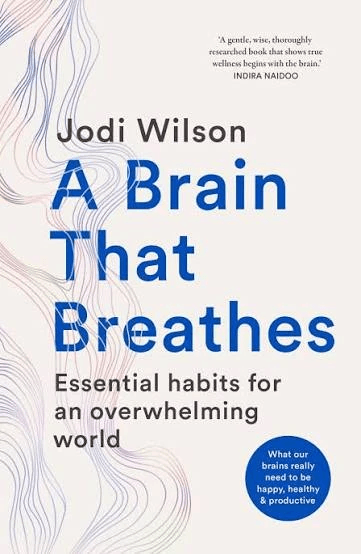
A Brain That Breathes: Essential habits for an overwhelming world, is the latest book from Jodi Wilson.
I’m in the process of researching for my next book and absorbing excellent authors like Jodi to get their take on modern life.
I’m interested in the intersections- of neuroscience, well-being, mental health and simpler ways of living and then how these can be intertwined with creativity and the life advantages this provides.
In her new book the author provides evidence based insights into the wellness industry, the digital obsession and overall contributors to burnout. She notes that while our external environments have advanced exponentially, our brains remain fundamentally unchanged from those of our ancestors 10,000 years ago.
“Sometimes we make space by repairing and making things. Crafting with your hands…requires your connection to the work you’re shaping…Creative pastimes aren’t frivolous, they’re resourceful and they nurture is us a sense of purpose that gives life meaning” pg 205
"Holding string in your hand- weaving, knitting or knotting it- is a gentler path from busyness to nothingness, because keeping your hands busy gives your brain the opportunity to slip into default mode" Pg 177
"Repetitive soothing movements,…nurture a feeling of calm and contentment" Pg 206
To start with she outlines what we need to live well and captures this with
- A calm nervous system
- An uncluttered brain
- A safe nourished body that moves and rests, and
- Breathing space.
These touch on many areas I’ve written about before on exercising the brain to build new pathways and strengthen weak ones, moving /walking / deep breathing , getting outdoors, and where needed Green Social Prescribing by engaging in nature based activities, all proven to boost and benefit creativity.
She then provides practical, simple ideas and strategies to achieve this. While it may sound a bit repetitive at the core argument is a series of interventions that anyone can practice.
I particularly enjoyed the twelve distinct areas that build a strong argument for living with less, slowing down and practicing self-care. All of this to build a further link to our internal states assisting and fuelling a creative flow and problem solving abilities.
She points to a number of core principles that link to both biological and behavioural processes like:
Being aware of living with stress and high cortisol to deal with the immediacy of life.
This works against creativity as we strive to enter a state of flow and a regulated state.
“ Why does flow make us feel good? In a flow state there’s decreased activity in the prefrontal cortex, a process known as transient hypofrontality, which leads to feelings of time distortion and loss of self consciousness. Flow is associated with the brain’s reward circuitry, enhancing curiosity and engagement, hence it induces the release of dopamine, boost well-being and acts as a magnet for learning , the development of new sills and challenges.” Pg 174
Reclaiming boredom, mind wandering to enhance our curiosity and
to enable small, unstructured ideas to rise.
“Boredom is essentially being alone with your thoughts… It forces us to break out of routine and come up with new and innovative ideas. It is this state of mind that we are more likely to take risks, experiment and try new things… think of boredom as the precursor to creativity, the necessary step to broaden our thinking and stimulate new ideas. It’s the push we need to make progress” pg 172-173
The beautiful term, soft fascination, the act of passively observing nature, such as watching
clouds or looking at the horizon—as essential for resetting our cluttered brain.
Overall she builds a strong case for how we can enable imagination and creativity by building unallocated time into our lives. It successfully reframes rest not as a reward to be earned, but as a biological necessity required to for a fulfilling and creative life.
The 12 distinct areas are:
- Pay attention to the gaps – Learning to lean into the quiet, unallocated moments between daily tasks rather than automatically filling them with stimulation.
- Befriend your vagus nerve – Activating the body's natural relaxation system using targeted physical resets like deep sighing or shaking out tension.
- Find your best forms of rest – Moving beyond sleep to discover customized ways to recharge mentally, emotionally, and socially.
- Honour the season you're in – Recognizing your current energy capacity and accepting that human productivity naturally ebbs and flows.
- Slow down and sidestep – Intentionally stepping out of the fast-paced societal treadmill to protect your baseline mental peace.
- Check your habits – Auditing the automatic routines and behaviours—particularly digital ones—that secretly drain your energy.
- Savour the good – Practicing slow, deliberate attention on micro-moments of comfort to rewiring the brain away from stress responses.
- Restore your attention – Utilizing techniques like "soft fascination" in nature to give an exhausted prefrontal cortex a chance to recover.
- Let your mind wander – Intentionally cultivating daylight daydreaming and analog boredom to unlock problem-solving states.
- Walk the in-between – Embracing transition periods (like commutes or evening winds-downs) as sacred spaces rather than dead time.
- Repair and make space – Decluttering your commitments, physical environments, and internal expectations.
- Build space to create – Structuring long-term, unallocated leisure time so that your creative drive has room to safely surface and thrive.